The Mid-Range Strike Drones Crippling Russian Logistics
Russian logisticians are facing one of their biggest challenges of the war, and it’s from the strategic gap filled by Ukraine’s new mid-range strike drones.
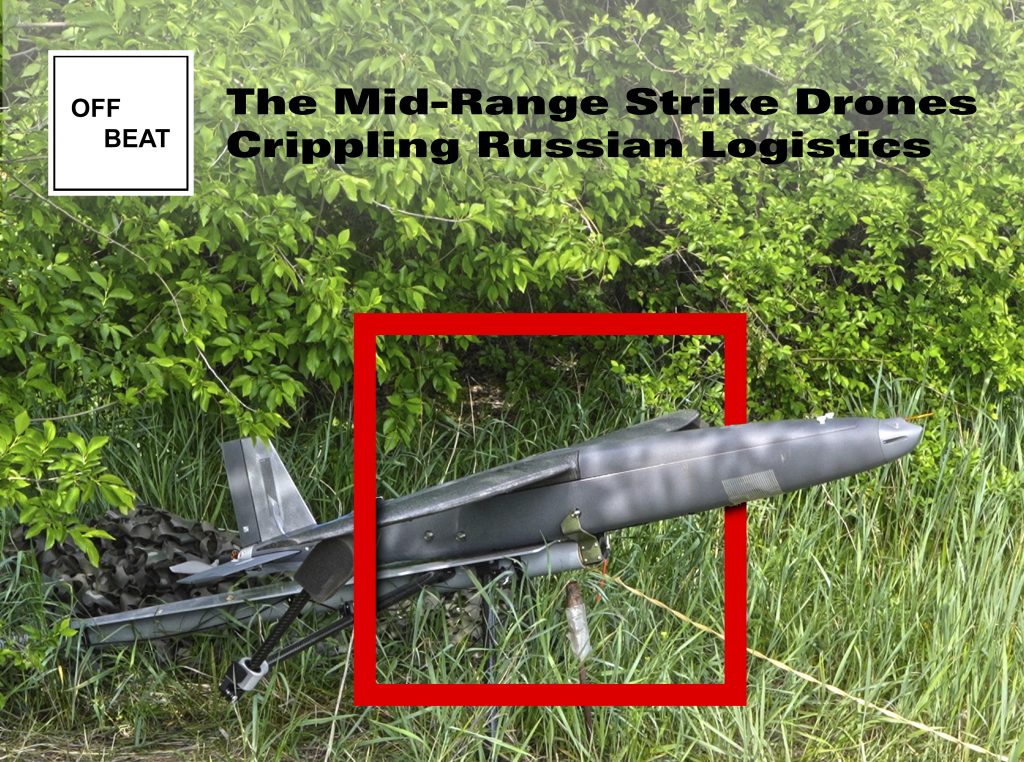
I’m standing with the commander of a drone team fighting under the 15th Operational Brigade “Kara-Dah”, which had been recently reassigned to operate Hornet drones on the Donetsk axis. Today, they’re preparing a slingshot-launched drone for an attack mission.
This mission is intended to patrol a popular logistical route for Russian logistics and troop transport, and attack whichever Russian military truck is unfortunate enough to be spotted by the team. If any Ukrainian recon drone was to spot enemy transport, teams like this can be informed of the potential target and quickly deploy their drones — especially since these vehicles travel along roads Ukrainian drone teams are well aware of, and map out their strike missions on their tablets accordingly.
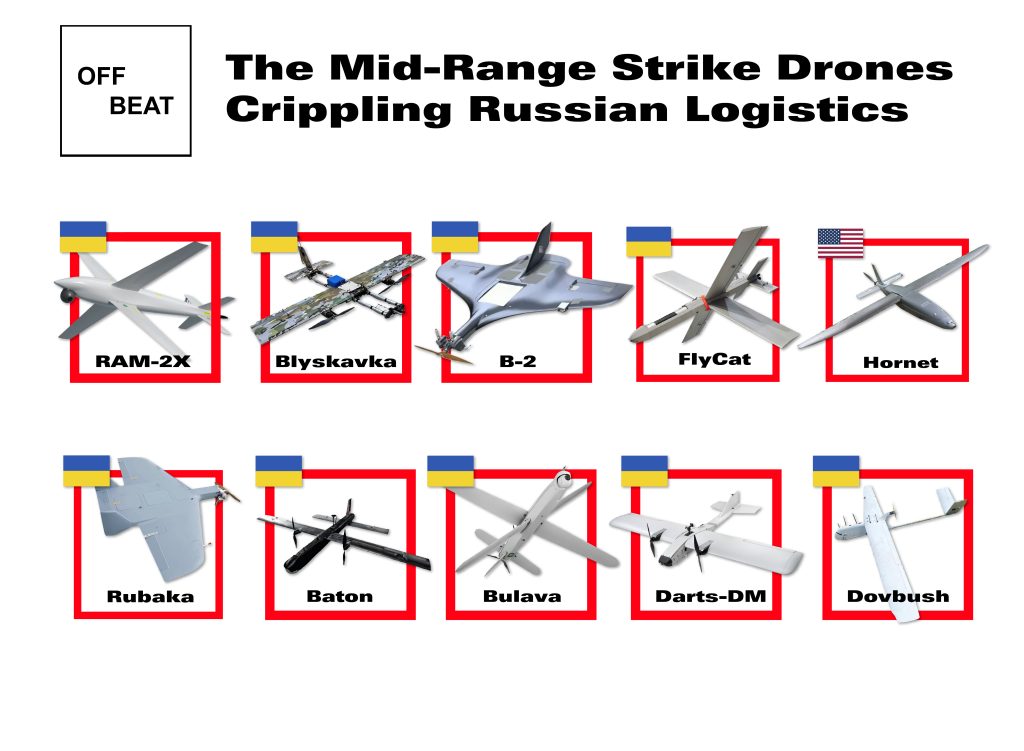
A non-exhaustive list of mid-range strike drones commonly used by Ukrainian forces.
“We sometimes hit enemy artillery, but our priority target is enemy trucks and transport. We try to stop enemy movement as much as possible,” said the lead of the drone team I embedded with, who preferred to remain unidentified.
There have been two major arenas for the majority of the drone war in Ukraine.
There’s the close range, with FPV drones strapped with anti-tank warheads and IEDs, grenade and mine-dropping Mavics that make tall grass a nightmare to walk in, and larger night bomber quadcopter drones carrying payloads large enough to bury soldiers inside their dugout.
Then there’s the long-range war, which has most radically changed in the quantity of long-range drones that Ukraine has at its disposal and the documented range of their use further and further across Russian territory, having traversed well over 1,000km (over 621mi) on multiple occasions.
This forces Russia to stretch their already overstretched air defense systems across an increasingly large swath of land. The only missing element, until relatively recently, was the capacity for mid-range strike drones built in any sufficient quantity to meaningfully restrain Russian logistics. This has been a significant gap in Ukraine’s largely successful drone campaign, impacting the army’s capacity to restrain Russian resupplies and ammunition replenishments before they reach their destination.
These systems — a joint US-Ukrainian venture — have flown much deeper than any FPV drone could. They can go over 90km (56mi) off radio waves alone, but can penetrate much deeper with a Starlink system attached to provide a clearer satellite-based connection.
“If we had this system sooner, it would’ve been much better because it can strike deep behind enemy lines to disrupt their movements and logistics quite effectively,” said the drone team lead. “It is a highly effective tool right now. We used to rely on standard FPVs and fiber-optic drones for deep strikes. Now, this system allows us to strike the enemy from 60 kilometers away and really make their lives miserable.”
The importance of a strong connection was shown to me later. After the team launched their drone with a slingshot, they mapped out their path, went along their route, and flew almost perfectly, only to lose the drone to radio signal jamming deep behind enemy lines. They explain to me that this was the third time this has happened; the majority of their time they are able to finish the mission, but this highlights a real risk in terms of connectivity when using analog connections.
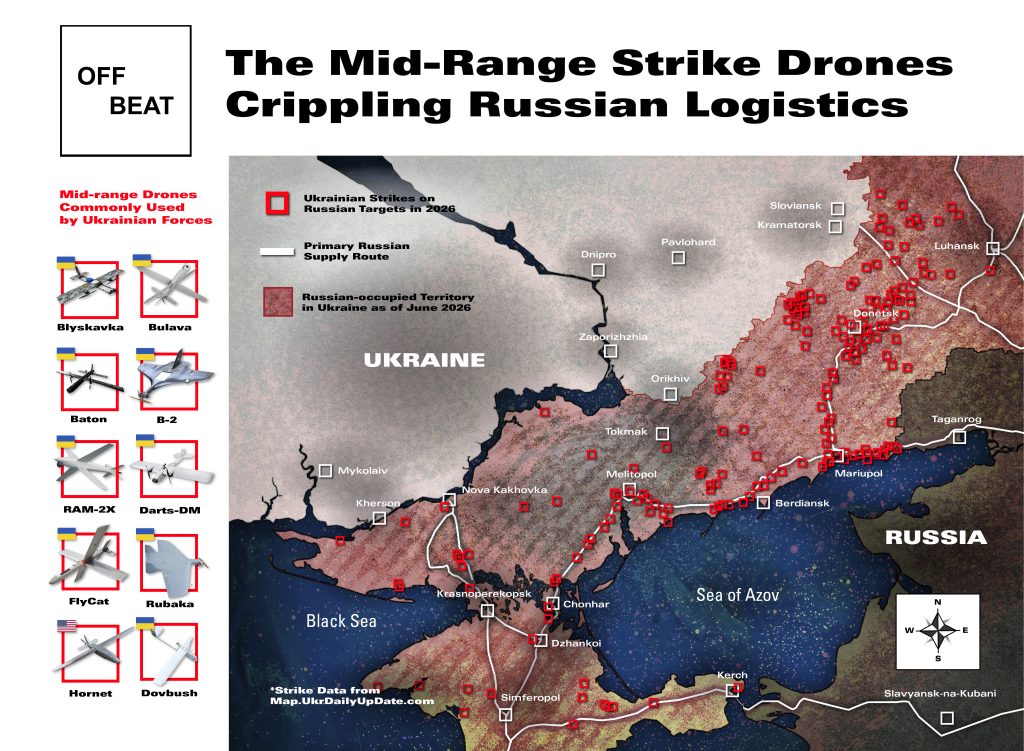
Videos shared online by the 12th Special Purpose Brigade “Azov’ show them targeting the roads outside Mariupol. They were one of the first to get the Starlink attachments the pilots in “Kara-Dag” who I embedded with yearn for. The more their use expands, the stronger the connection will be across the board for pilots, meaning less jamming and deeper successful missions. For example, Azov has even been able to target port infrastructure in Mariupol used by occupation authorities.
“This system is fairly effective. It feels good to operate it,” the team lead explained. “Unfortunately, the enemy is adapting very quickly. The enemy adapts to our technology incredibly fast. They jam our frequencies and prevent us from doing our job. We need to improve this system to operate more effectively. Overall, it’s a good system – it gets the job done.”
The end result of this increase in capacity to target Russian mid-range targets is destroyed supply trucks, straining Russian positions in occupied Zaporizhzhia and Kherson. The road from Rostov-on-Don to Mariupol to Russian positions in the south is now under constant threat. There isn’t a way to get necessary supplies to the occupation forces in the south without putting transport at risk. This has already resulted in fuel prices in occupied Melitopol increasing rapidly, with Russian air defense assets being reassigned and remobilized to counter these drones. Russian supply trucks also have started switching up their pre-planned routes in order to keep Ukrainian drone pilots guessing. This is not a phenomenon restricted to southern supply routes, as these mid-range drones have also hit targets in Ukraine’s occupied eastern regions, like in Luhansk.
For its part, Russia is quite familiar with mid-range strike drones. Many Ukrainian soldiers lived with ample knowledge of Russian drones like the Lancet, which stalked the battlefield for Ukrainian vehicles and positions for years.
Over the past year, the dynamic has been inverted, with mid-range drone attacks from Ukrainian forces increasing significantly in frequency over the past six months. There no longer seems to be anywhere Russian forces operate inside occupied Ukraine that is left out of range of Ukrainian drones, especially as Ukrainian drone strikes in Russia occur with increasing frequency and ferocity.
“It’s all leading to us sitting in dugouts fighting with a controller,” the drone team lead theorized. “We won’t even have to be on the frontline. We could be fighting the war straight from home. Most of the world will switch to drones. Infantry will not disappear, but I think drones will be adapted for this task. We’ll most probably be fighting straight from home. It’s going to happen soon.”