
The Secret Deconfliction Line: How Assad Sold His Allies With the Help of Russia
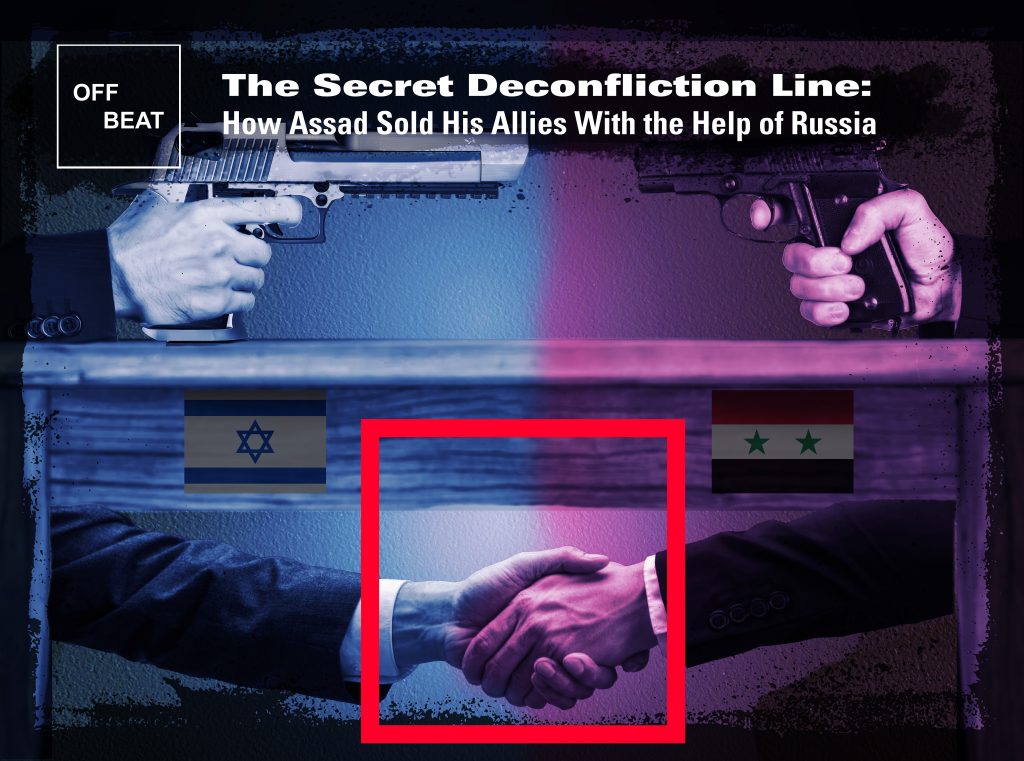
OP-ED: Much of the world’s attention on the Middle East has been focused on the man-made famine in Gaza, the collapse of the Assad regime, the rise of former Al-Qaeda fighter Ahmed al-Sharaa to president of Syria, and the sectarian clashes and massacres that happened in predominantly Alawite and Druze regions of Syria on the new government’s watch. In the midst of growing uncertainty about sectarianism and instability, Israel is ramping up attacks and seizing territory from the war-torn nation, invading beyond the previously declared ceasefire line which had stood for decades. The actions amount to a declaration of war on the post-Assad government before it has even fully consolidated power.
Assad’s departure on December 8, 2024 set off what Israeli officials described as one of the largest bombing campaigns in the history of its air force, crippling what remained of Syria’s military infrastructure.
The attacks may seem baffling to outside observers as Israel’s principal enemy in the immediate vicinity, Hezbollah, withdrew from Syria in December 2024 amid the collapse of the Assad regime. However, the recent escalations are part of Israel’s strategy of trying to establish red lines after the collapse of a long-standing arrangement with Russia, which as documents captured after the fall of the Assad regime show, gave the Israeli air force broad freedom of action in Syria during the last decade of Assad’s reign.
The Israeli reaction to Assad’s fall has been opportunistic, with Netanyahu’s government taking aggressive positions, killing Syrians in the hundreds, and seizing land.
The emergence of a nascent state that is neither subservient nor overtly hostile to Israel puts Israel’s maximalist goals under new scrutiny. The Israeli government cannot reasonably claim self-defense under customary international law, and have thus turned to a series of often contradictory messages for increasingly naked aggression. Where most of the international community that the tumultuous divisions of post Assad Syria are a challenge to be overcome, Netanyahu sees the instability as an opportunity.
Israel’s Occupation of Syrian Territory Post-December 2024
Since December 2024, Israeli forces have moved further into Syrian territory, occupying villages and clashing with locals. In one case, an Israeli drone strike killed a local mayor who appeared to have been negotiating on behalf of residents. Images have recently emerged of new Israeli military structures inside Syria, which indicate a move to a permanent military presence. Additionally, the Israeli military has admitted to detaining Syrian citizens inside Syria, exercising the authority of an occupying force.
Public statements from Israeli leaders have also grown increasingly hostile — with government figures, including Netanyahu, saying that the collapse of Assad did not serve Israel’s interests.
The backdoor dealings of the Assad era have been replaced by both more overt hostility from Israel and more public overtures for negotiation from the Syrian Transitional Government (STG). The Israeli government has set a red line against STG forces being stationed in any meaningful way in the south of Syria, and has conducted airstrikes under the pretext of enforcing this red line.
An already tense situation in southern Syria escalated further in July when forces loyal to the Druze Sheikh Hikmat al-Hijri ambushed STG forces, killing dozens. Subsequent clashes erupted into sectarian violence, as STG forces documented themselves systematically killing Druze civilians. Clashes with Bedouin fighters ended in mass displacement of both Bedouin and Druze civilians. Al-Hijri would go on to openly thank Israel for intervening on behalf of the Druze community.
For its part, the Israeli government stated that it would defend the Druze in Suwayda, with Israeli Defense Minister Israel Katz saying, “we will not allow a massacre of our Druze brothers just across our border.” According to media reports, the STG had been given a green light in July by the Americans to enter Suwayda to confront Al-Hijri, leading them to believe they would not be interdicted by the Israelis. Instead, the Israeli military launched a significant air campaign against the STG, which included airstrikes against the Ministry of Defense in Damascus, and near the Presidential Palace. Multiple images posted to social media purported to be from Al-Hijri supporters in Suwayda show them displaying the Israeli flag on municipal buildings and elsewhere. Additionally, the Israeli government has allowed a large number of Druze from the occupied Golan to enter Syria, though it denies allowing fighters to cross.
The situation on the coast, meanwhile, is still boiling, with reports of young men fearing for their lives amid both a swirl of rumors intended to stoke division, and irrefutable proof of sectarian massacres carried out by STG allied forces against local Alawites. Recent weapons seizures also show that there is still a well-armed contingent of Assad loyalists who will still pose a threat to the government’s fragile position. Additionally, U.N. experts have expressed concerns about the kidnapping of Alawite girls.
A peace deal agreed between self-appointed interim president Ahmed al-Sharaa and SDF leader Abdi Mazloum was yet another unexpected twist in the complicated months following the fall of Bashar al-Assad. As part of the agreement, areas controlled by the Autonomous Administration will now nominally come under government control.
Though the peace deal between the SDF and the Transitional Government is a hopeful sign, it is tenuous and multiple conflicts are still ongoing. For its part, the Israeli government has made it clear that it will be one of many destabilizing forces in the near future.
The New Syrian Government and the Palestinian Cause
The new conciliatory stance of the Syrian government towards Israel is a stark contrast to the rhetoric of many of its supporters, who displayed symbols affiliated with Palestinian fighters during the fall of Assad. For their part, Hamas representatives issued statements congratulating the opposition for the regime’s collapse.
The ideological solidarity between the former Syrian opposition and Palestinian nationalists is rarely examined in Western circles, but it is significant. A large number of Palestinian fighters were involved for years in the Syrian opposition against Bashar al-Assad, with claims made that certain guerilla warfare techniques had been taught by Palestinian volunteers. For his part President Assad accused Hamas of supporting the rebellion against him. In the early years of the Syrian civil war, Hamas openly sided politically with the opposition.
Prominent Palestinian journalists and public figures, particularly in Gaza, expressed joy at the collapse of the Assad regime. Though the feeling was not necessarily universal, it was echoed by various militant groups in the region including Hamas, and perhaps surprisingly, Hezbollah, who issued an uncharacteristically nuanced statement about the end of the regime.
During its reign, the Assad regime, like Israel, was well-practiced at meddling in neighboring countries, often via violent proxies. Hafez al-Assad put a particular emphasis on stirring inter-Palestinian conflict and inter-Lebanese conflict, particularly during the civil war in Lebanon. The Palestinian splinter group Fatah al-Intifada was supported by the Syrian regime to undermine Yasser Arafat, and the PFLP-GC under Ahmed Jibril was created with support from the Assad regime to undermine other Palestinian factions, even fighting against the PLO on the side of Syrian forces in 1975.
Even into the early 2010s, the Assad regime used terror bombings against civilians to spark religious and sectarian infighting to further its own interests. In August 2012, Lebanese politician and long-time Assad-regime ally, Michel Samaha was arrested for transporting explosives with direct instructions from the head of the Syrian regime to detonate them at Sunni and Shia mosques to cause sectarian fighting.
“There are two people that know [about the bombs], Ali Mamlouk and Bashar al-Assad.”
— Michel Samaha, filmed on hidden camera
Israel’s complicated status quo with the Assad regime meant the ceasefire line, which had been in place since 1974 for a conflict that was technically never resolved, remained essentially quiet for decades.
The Israel-Russia-Assad Axis
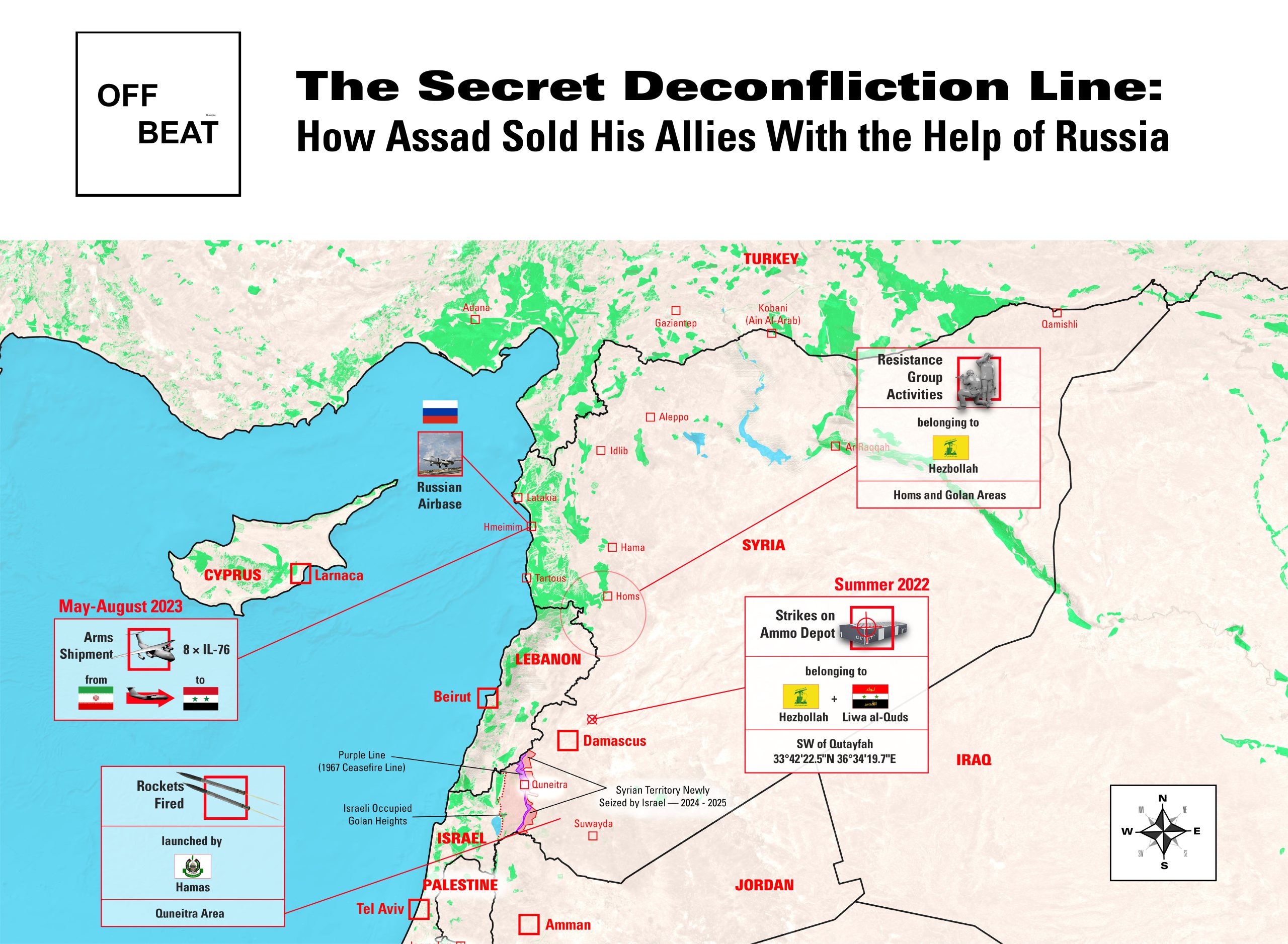
The strikes on the heels of Assad’s departure against defense infrastructure, aircraft, intelligence bases, and purported chemical warfare facilities revealed how extensive Israel’s knowledge of the regime’s military apparatus was. It also unmasked the level of disturbing complacency the Israeli government had with the Assad regime’s position in Syria.
Assad’s departure is the final chapter in a crisis of faith that was brewing between the now-deposed regime and one of its most prominent backers, the Lebanese Shia militant group Hezbollah. The regime, along with Iran and Hezbollah, formed what they called “The Axis of Resistance” against Israel.
Russia’s 2015 direct intervention in support of the Assad regime created an awkward diplomatic situation where a country with excellent relations with Israel was fighting alongside a Lebanese militia committed to its destruction. The situation should have been awkward for Russia and Israel, but the two countries soon reached a status quo that gave the Israeli air force near-free reign to strike Hezbollah targets inside Syria.
When the sporadic exchanges of fire between Israel and Hezbollah in the wake of the October 7, 2023 Hamas attacks escalated into full-scale war in 2024, Hezbollah retained a large force in Syria yet refrained almost entirely from launching any attacks in support of its fight against Israeli forces.
In Arab and Israeli media, speculation has begun that the regime’s relationship with Russia may have extended to tacit cooperation with Israel. The release of documents purporting to show communications between the Israeli military and the Assad regime military reinforce a long-running suspicion that Assad played, at the very least, a tacit role in selling out Hezbollah to the Israelis.
Conservative estimates suggest over 1,000 Hezbollah fighters died in Syria for Bashar al-Assad, but the fundamentalist group’s relationship with the Ba’ath dictatorship was always a strange marriage of convenience built on shaky ground. Since the regime’s fall, the former dictator’s legacy has come under increased suspicion amongst many of those who once considered him a pillar of the resistance against Israel.
Though Assad’s favor had long fallen out in the Sunni world, he still retained strong backing from Hezbollah and their supporters. Hezbollah was more subdued about publicizing its battle against the Syrian opposition than its confrontations with Israel. Nonetheless, Assad’s unpopularity led to Hezbollah falling out of favor with many in the Middle East. When longtime Hezbollah General Secretary Hassan Nasrallah was assassinated, reaction was muted in many parts of the Sunni world, and even celebratory in others.
“In 2006, Hassan Nasrallah was like a rockstar across the region. You would see his picture in Armenian areas regardless of sect,” says Professor Joseph Daher, a prominent scholar on Hezbollah and author of Hezbollah: The Political Economy of Lebanon’s Party of God.
Daher subscribes to the view that the Assad regime’s self-proclaimed status as a resistance nation was one of many contradictory positions the government used in its power plays, and that Hezbollah served a practical rather than ideological purpose.
“While Hafez al-Assad always saw Hezbollah as a tactical tool to be used in negotiations, especially with Israel, this relationship changed with Bashar al-Assad — that saw it as a strategic ally rather than a tactical ally — so it allowed Hezbollah to gain much more important weapons and transfer of weapons,” says Daher.
According to Daher, while the Israeli military was conspicuously comfortable with Assad’s substantial arsenal, they immediately set out to destroy it the moment he lost power.
“It’s not only about chaos, it’s sending a clear political message that any democratization process in the Middle East will be seen as a threat, and sending a political message for the future people in power,” says Daher.
With the focus of the militant group almost solely on Syria for the last decade, Hezbollah’s border with Israel remained mostly quiet since the ceasefire in 2006. But the October 7, 2023 Hamas attacks and the subsequent genocidal war on Gaza dragged Hezbollah back into direct conflict. Limited cross-border strikes between Israel and Hezbollah seemed like normal tit-for-tat escalation. This awkward balance remained for almost a year, but the dynamic would soon break, along with a lot of the old paradigms in the Middle East when thousands of pagers exploded across Lebanon on the 17th and 18th of September 2024, and Hezbollah’s leadership was decimated in a series of subsequent Israeli airstrikes.
The decapitation of Hezbollah in Lebanon was a sudden shock to supporters of the militant movement. In many ways, the sudden decimation of Hezbollah was the culmination of a 10-year war that Israel fought against the militant group in Syria with the cooperation of the Russian military and the tacit approval of the Assad regime.
The sudden diminishment of Hezbollah’s capabilities and Russia’s preoccupation with its invasion of Ukraine left the Assad regime weaker than ever. What at first appeared to be a limited counter attack by anti-regime rebels in Idlib in late November, led to government lines collapsing like a house of cards. In mere days, the regime was no more.
With the regime out, Israel’s air force launched a rapid series of airstrikes against military infrastructure, intelligence bases, and purported chemical weapons facilities that the former regime had left in place for decades. The ferocity of the strikes raised questions about why the Israeli government was so unperturbed by Assad controlling such an arsenal for decades.
“They didn’t fear Assad in power or they didn’t fear that Assad would jeopardize their interests or be a threat for Israeli borders, but I think the biggest proof is really: the day after he was overthrown, they bombed,” says Daher.
The collapse of the regime and the massive Israeli bombing campaign against the new Syrian government sheds light on the deconfliction mechanism that Russia and Israel used to avoid confrontations inside Syria. The arrangement amounted to the Israeli air force having a free pass for parts of Syrian airspace with Russia’s consent.
“The argument that Israel bombed Syria for the past decade, it was specifically targeting, 99% of the time, pro-Iranian pro-Hezbollah targets. This was not the case anymore. This is the best proof to all the people who are saying this regime was resistant or anti-imperialist,” says Daher.
Leaked Documents Show Secret Assad-Israel Collaborations
After the fall of the Assad regime in December 2024, the regime’s omnipresent security installations were quickly overrun by Syrian citizens, who sought to both ransack the regime’s ill-gotten gains and to expose documents detailing the status and condition of their loved ones. Amid this frenetic overthrow, many papers were seized by civilians from regime facilities, detailing many previously undisclosed aspects of the Assad regime’s sweeping intelligence apparatus and back-room dealings.
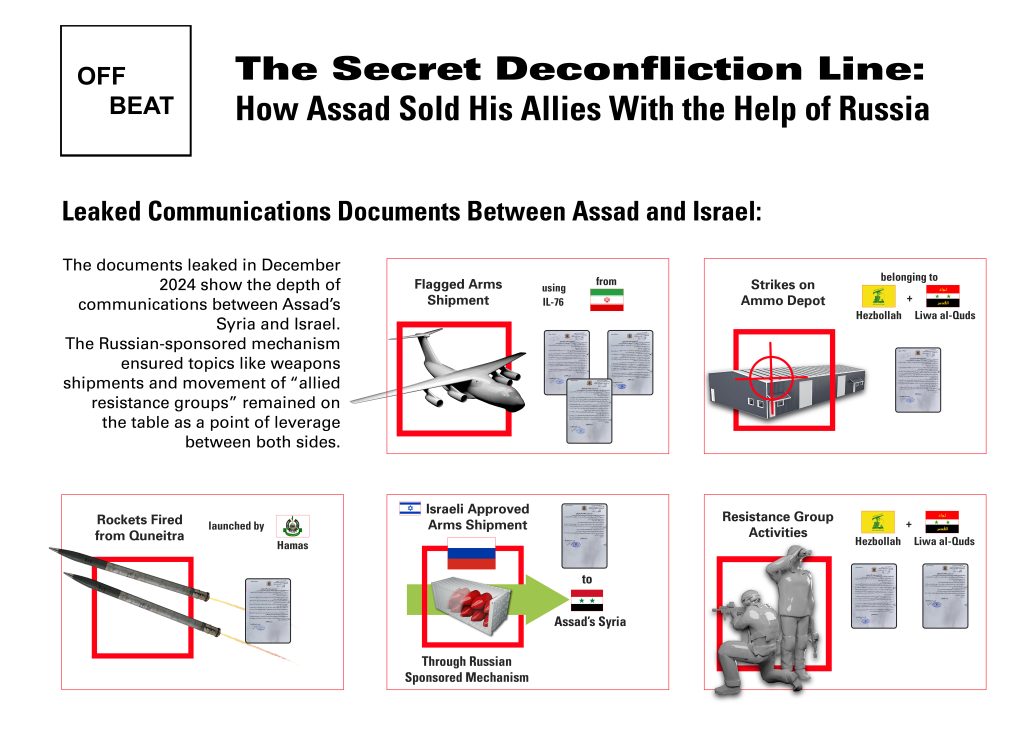
During this time, a series of what are purported to be Assad regime intelligence documents were uncovered from various intelligence facilities across Syria, and began circulating online amongst Syrian journalists at the end of 2024, when they were subsequently released in a report by Al Arabiya. The transcripts allegedly show a log of communications between the Israeli military and the Syrian military. An examination of the content of the documents shows that many of the strikes mentioned plausibly match the known timeline of Israeli airstrikes in Syria, and were written by someone with substantial understanding of the deconfliction system between Russia and Israel.
While most of the messages seem like standard warnings from a hostile neighbor, some suggest that the Syrian military may have at times, allowed the Israelis to lay traps for their Iranian and Hezbollah allies without sharing a warning.

– April 8, 2023
“As you know, on the 8th of April, 2023, three high explosive missiles were fired towards Israel from the location of the Golan Heights, directed by Hamas.”
Upon reviewing media reports from the time, it is clear that this message is consistent with the correct timeline of Israeli strikes, with a seemingly identical incident having been reported concurrently.
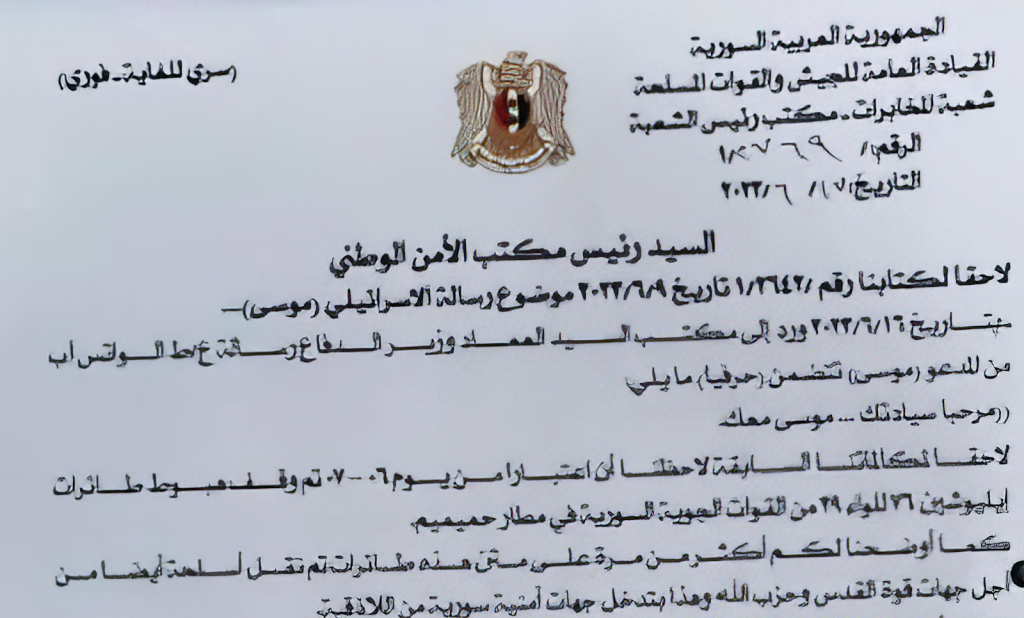
“Syrian Arab Republic, General Staff of the Armed Forces, Secret Service Division Office of the Chief of the Secret Service: On the 16th of June, 2022, a Whatsapp message was received by the office of the Minister of Defense from the so-called “Moses” the literal content of the letter is as follows: ‘Good day your Excellency, this is Moses. Following our previous conversation, we have noticed that since the 6th and 7th, we have stopped two IL-76 aircraft belonging to the 29th Brigade of the Syrian Air Force from landing in Hmeimim airport. As we have told you time and time again, these airplanes are transporting weapons, also to the Quds Force and Hezbollah. This is being done with the intervention of Syrian Security Forces from Latakia.”
– June 17, 2023
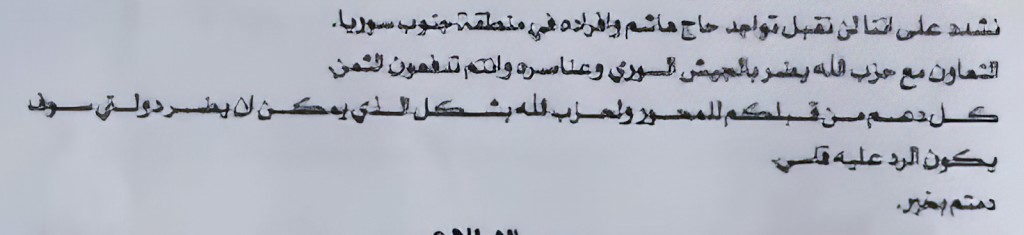
“We reiterate that we will not accept the presence of Haj Hashem (Hashem Safieddine, Hezbollah’s second-in-command at the time) and the members of his group in the area of northern Syria. Cooperation with Hezbollah harms the Syrian army and its members. You are paying the price of all the support you provide to the Axis and Hezbollah in ways that can damage my country, and the response will be very harsh. All the best.”
– May 29, 2022
Safieddine was selected as Hassan Nassrallah’s successor after the Hezbollah leader was killed in an Israeli strike on September 27. On October 3, Safieddine was also killed in an airstrike.
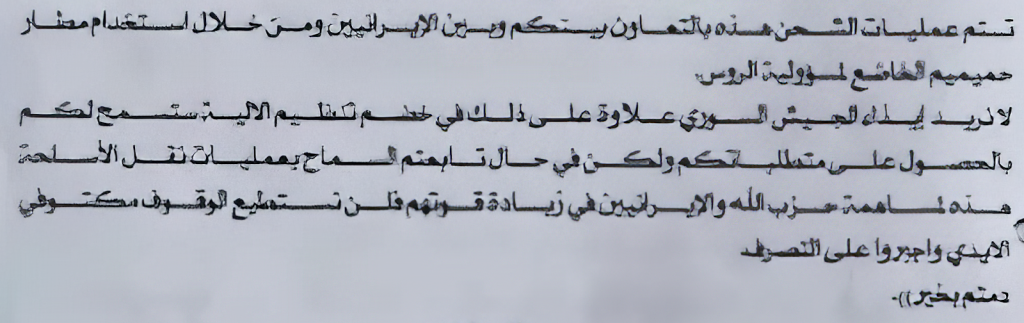
“… these shipping operations are done in cooperation between the Iranians as well as using Hmeimim airport, which is under the responsibility of the Russians. We do not want to hurt the Syrian army. On top of that, in terms of the mechanism, we will allow you to get your needs, but if you continue to allow these operations of transferring weapons to Hezbollah and the Iranians and increasing their might, we will not stand by idle-handed and we will be forced to act. All the best.”
– June 6, 2023
The implicit suggestion from how the language is worded is that some foreign military presence, or weapons supply, was considered acceptable to meet the needs of the regime so long as it did not threaten Israel. In context, it’s worth noting that despite a very strong position to do so, Hezbollah did not launch any attacks on Israel from Syria.
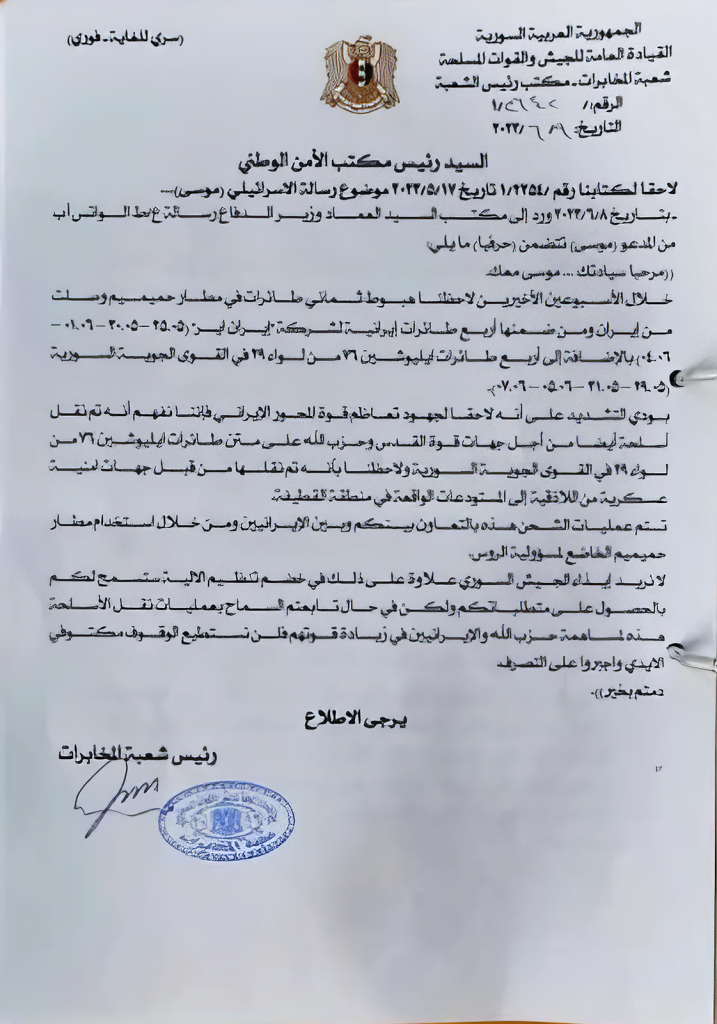
“In the last two weeks we have noticed 8 Iranian airplanes landing in Hmeimim, including 4 Iranian airplanes and 4 more Iluyshin airplanes from the 29th Brigade (Division 29 air-force cargo). I would like to reiterate that because of the increase of Iran’s access, we understand that a lot of weapons are being moved to the Quds force and Hezbollah aboard these Iluyshin 29s, and they are being transported from military security from Latakia to warehouses in the Qutaif area. These operations are being done between you and the Iranians using Hmeimim, which is under the authority of the Russians. We do not want to hurt the Syrian Army. On top of that, in accordance with our “mechanism” we will allow you to have your demands but only if you stop the movement of weapons of Hezbollah and the Iranians. But if not, we cannot stand idle handed and be forced to act.”
– June 8, 2023
As the country emerges from generational dictatorship, Israel has taken an arsonist approach to the situation, with even traditional allies accusing the Netanyahu government of inciting chaos.
Meanwhile, Syria’s transitional government is seeking middle ground to avoid conflict. It has forged a new relationship with its former Russian enemies, allowing their military to remain on bases, importing supplies, and sending diplomats to Moscow.
The conciliatory approach to Russia is one of many ways the new Syria is showing frightening echoes of the old Syria. Credible reports show that detainees have been tortured and killed on the transitional government’s watch, including Youssef Al-Labbad, who died in custody mere days after being detained by security forces at the Umayyid Mosque in Damascus.
While accountability for human rights violations seems elusive at best, the new government has nonetheless attracted promises of large investments from Gulf nations like Saudi Arabia and Qatar. A July investigation by Reuters detailed how economic power is being concentrated around loyalists in Interim President Ahmed al-Sharaa’s inner circle, including his brother Maher al-Sharaa.
As the dynamics shift and new powerful players emerge, the luster of the former regime continues to fade. Hafez al-Assad Ave. in Beirut has been renamed for late musician Ziad al-Rahbani. It is clear that however circumstances evolve in the future, the dynamics wrought by the grip of collaborationism between Israel, Russia, and the Assad regime are no longer a looming spectre over the region’s inhabitants.
